

The seed processing production line is one of the high-demand industries in the agricultural sector, adding value to producers, distributors, and end consumers by converting raw seeds into final ready-to-eat products such as seed kernels, roasted seeds, and flavored seeds.
Given the growing consumption of healthy snacks and increasing demand for local products, investing in an efficient production line can create a profitable opportunity—especially if you pay attention to factors such as setup prerequisites, economic benefits, and proper equipment selection. In this guide from the Seifi website, we will comprehensively review the seed processing production line.
Types of Seeds in Iran
Types of Seeds in Iran

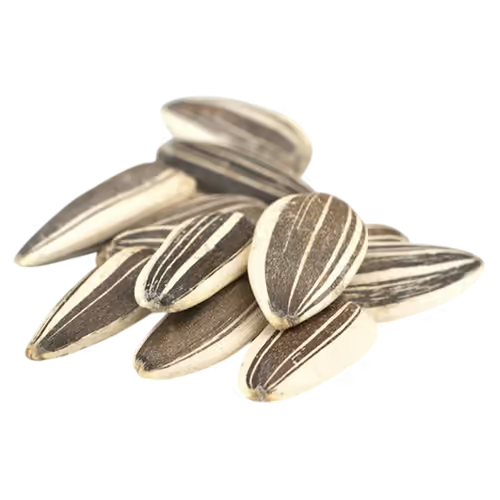
The most common seed in the Iranian market is sunflower seed, found in various types such as elongated, Canadian, and small hazelnut-sized varieties. Pumpkin seeds and Japanese seeds are also popular nuts among Iranians. In another classification, seeds are available in raw, roasted, or flavored types. This means that the seed harvested by the farmer must go through several stages to become tasty and have an extended shelf life before reaching the consumer.
What is a seed processing production line?
A seed processing production line is a set of specialized machinery and equipment used for washing, shelling, drying, roasting, flavoring, packaging, and quality control of seeds.

These lines transform raw seeds into attractive, consumable final products. Modern processing lines, using advanced technologies, enable the production of diverse, high-quality products in large volumes.
In the seed production line, raw seeds are first transferred to the factory and cleaned of thorns, leaves, soil, and other foreign materials. For this purpose, the seeds are washed with water and separated from contaminants. The seeds then need to be sized by dimensions. Next, the hard shell of the seeds is removed using shelling machines.
The shelled seeds are dried to prevent mold and increase shelf life, typically using dryers with controlled temperatures. Finally, depending on the order and the line’s objective, the seed kernels are roasted or flavored. With these explanations, you can summarize the benefits of a seed processing line as follows:
● Increased Productivity: Modern processing lines significantly boost productivity by reducing labor and increasing production speed.
● Improved Product Quality: Using precise equipment and quality control at every stage enhances the quality of the final product.
● Product Variety: Processing lines allow for the production of seeds with different flavors and sizes, enabling producers to meet diverse customer needs.
● Waste Reduction: By separating foreign materials and defective seeds, waste is reduced and profitability increases.
● Extended Shelf Life: Proper drying and packaging processes increase the shelf life of seeds.
● Value Addition: Processing seeds adds significant value to the product, increasing profitability for farmers and producers.
Setting Up a Seed Production Line
Setting up a seed processing line is a significant investment that requires careful planning. You must consider various aspects. In this section, we examine the essential steps and equipment for establishing a seed processing plant:
Initial Steps and Planning
To plan for setting up a seed processing line, the following steps should be taken:
Market Analysis:
Before anything else, you must analyze the market thoroughly. What type of seeds is there demand for? Who are your competitors? How are prices determined?
Determining Production Capacity:
Based on your market analysis, determine your desired production capacity. Are you planning to set up a small line with limited capacity, or a large industrial line?
Preparing a Feasibility Study:
Prepare a comprehensive feasibility study that includes cost estimates, revenue projections, profitability analysis, and return on investment.
Obtaining Permits:
To set up the production line, you must obtain the necessary permits from relevant organizations such as the Ministry of Health, the Ministry of Agriculture, etc.
Physical and Equipment Requirements
Before anything else, you need a workshop hall. The required hall area depends on production capacity and equipment type. Generally, for a small to medium production line, at least 200 to 500 square meters of hall space is needed.
Next, you need to consider hiring operators and workforce. The number of operators required also depends on production capacity and the level of line automation. Typically, a small production line requires 5 to 10 operators, while a large line requires 15 to 30.
Seed Processing Equipment
The most critical part of setting up a production line. In a complete seed processing line, you typically need cleaning machines, shellers, washing machines, sorters, roasters, and flavoring machines.
Finally, know that the costs of setting up a seed production line vary depending on production capacity, equipment type, and other factors. Generally, the cost of setting up a small production line ranges from 500 million to 2 billion tomans, while setting up a large line ranges from 2 billion to 10 billion tomans.
What machines are included in a seed production line?
As mentioned, the seed production line is a set of specialized machines, each with a specific task in the seed processing process. In this section, we will take a closer look at some of the most important machines in this line:
Seed Cracking Machine
The seed cracking machine is one of the most important machines in the seed production line, responsible for breaking the hard shell and separating the seed kernel. The Seifi Group’s industrial seed cracking machine achieves over 90% shelling accuracy. Various types of seed crackers are used depending on the seed type and its hardness or brittleness.
● Hammer Seed Cracker: This machine uses moving hammers to break the seed shell. This type is designed for seeds with hard shells.
● Roller Seed Cracker: This machine uses moving rollers to break the seed shell. This type is suitable for seeds with softer shells.
● Pneumatic Seed Cracker: This machine uses high-pressure airflow to crack the seed shell. This type is a very suitable option for seeds with very thin shells.
Seed Cleaning Machine
The seed cleaning machine uses airflow to separate broken seeds, seed kernels, shell particles, and other waste materials.

This skin separator plays an important role in improving the quality and purity of the final product. Seifi Group has designed this machine so that its output separately delivers seed shells, kernels, possible waste, and even dust. Various types of Seifi kernel skin separators are available in capacities of 100 and 300 kg/h. The 100 kg/h models operate on single-phase or three-phase electricity, while the 300 kg/h model runs on three-phase power. Additionally, all models allow air and vibration intensity adjustment.
Conveyor Elevator Belt
The conveyor elevator belt is used to transfer materials from one level to another. In the seed production line, the conveyor elevator belt is used to transfer seeds between different machines, as well as to move raw materials and final products to the warehouse. The capacity of the conveyor elevator belt generally ranges from 50 kg to 10 tons per hour (depending on the model). Various types of conveyor elevator belts from Seifi Industrial Group are manufactured and supplied in modular or PVC material, in horizontal, vertical, and inclined configurations.
Price of the Seed Processing Production Line and Factors Affecting It
The price of a seed production line varies according to several factors, and a fixed price cannot be provided. Generally, the cost of setting up a seed production line ranges from several hundred million tomans to several billion tomans. Factors affecting the price of a seed processing line include:
Production Capacity:
The higher the production capacity of the seed line, the higher the cost of equipment and required space.
Equipment Type:
Using automatic and advanced equipment increases the production line cost.
Automation Level:
The higher the automation level of the production line, the higher its cost.
Equipment Brand:
Equipment from reputable brands is usually more expensive.
Installation and Commissioning Costs:
You should also consider the cost of installing and commissioning the equipment.
Permit Costs:
You will also need to pay fees for obtaining the necessary permits from the relevant organizations.
Approximately, it can be said that a small production line with a capacity of 500 kg/h costs around 500 million to 1.5 billion tomans, a medium line with a capacity of 1 to 3 tons per hour costs between 1.5 and 3 billion tomans, and a large line with a capacity of 3 to 10 tons per hour costs 3 to 10 billion tomans.
Why the Seed Production Line from Seifi Industrial Group?
Seifi Industrial Group is one of the pioneers in the manufacturing of food processing machinery, especially for nuts, in Iran.

This group, with years of experience and expertise in designing and manufacturing seed production lines, has established a special position in the market. The advantages of choosing Seifi Industrial Group are as follows:
High Quality:
The machine bodies are primarily made of stainless steel, internal consumable parts are made of steel, and bearings are mostly Japanese.
After-Sales Service:
Seifi Group provides after-sales services including installation, commissioning, training, and repairs to customers.
Product Variety:
For each machine model in the processing line, various models with different capacities and performance options are available.
In addition to the above, it should be noted that Seifi Group machines offer excellent profitability for customers by reducing kernel breakage, precision sorting, and reducing manpower requirements. However, it is important to know that our machines are specifically designed and manufactured for sunflower seeds.
Most Important Challenges in Industrial Seed Processing
Industrial seed processing faces several challenges that require attention and careful management. These challenges include:
Flavor Uniformity Control
One of the most important challenges is maintaining flavor uniformity throughout the production process. Various factors such as seed type, moisture content, temperature, and roasting time can affect the final product flavor. To control flavor uniformity, precise equipment and automatic control systems should be used, and the roasting process must be carefully monitored.
Preventing Burning and Bitterness
Burning and bitterness of seeds are common problems in the roasting process. To prevent this issue, temperature and roasting time must be carefully controlled, and high-quality roasting equipment should be used.
Reducing Waste and Breakage
One of the factors reducing profitability in industrial seed processing is seed breakage. To reduce waste and breakage, high-quality shelling and sorting equipment should be used, and the shelling process must be carefully controlled. You should also ensure proper handling and transfer of seeds throughout the production process.
Final Word
Setting up a seed processing production line requires a thorough review of investment costs such as machinery, building, labor, understanding the economic benefits (reducing waste, increasing yield, enabling the production of various flavored types), and selecting appropriate equipment such as cleaners, sorters, shellers, moisture meters, roasters, etc. With proper planning and the use of up-to-date technologies, you can produce a product with consistent quality, cost-effectiveness, and market appeal.
Frequently Asked Questions
What is the minimum initial capital required to set up a seed production line?
Depending on capacity and automation level, the initial investment typically starts from over 200 million tomans.
How can seed production costs be reduced?
By optimizing energy consumption, using high-efficiency machines, recovering heat, and purchasing raw materials from local producers, you can reduce these costs.
Is a special permit required to set up this line?
Yes, you need to obtain health permits, quality standards (ISO or national systems), and food hygiene certificates from the relevant organizations.
What is the suitable daily working hours for a production line?
Most lines operate 24 hours with 2 or 3 work shifts. However, to start, you can begin with 8-12 hours per day.

